
Can Autism Be Diagnosed Before Age 2? What Every Parent Should Know

As parents, we eagerly wait for our child's first smile, first word, and first steps. We celebrate every milestone and often compare notes with friends and family.
But what happens when your child seems to be developing differently?
Perhaps they don't respond to their name consistently. They rarely point to show you something interesting. They seem unusually sensitive to certain sounds or textures. Or maybe you've simply noticed that something feels different, even if you can't explain why.
Many parents ask the same question:
"Can autism really be diagnosed before my child turns two?"
The short answer is yes.
In fact, research shows that autism can often be identified as early as 18 months, and in some children, signs may be noticeable even earlier. While every child develops at their own pace, recognising early signs and seeking professional guidance can make a meaningful difference in understanding your child's needs and accessing appropriate support.
Let's explore what parents should know.
What Is Autism?
Autism, or Autism Spectrum Disorder (ASD), is a neurodevelopmental condition that affects how a person communicates, interacts, learns, and experiences the world.
The word "spectrum" is important because autism looks different in every individual.
Some autistic children communicate verbally, while others may use gestures, pictures, or augmentative and alternative communication (AAC). Some enjoy social interaction but express it differently. Others may experience sensory sensitivities or develop strong interests in specific activities.
Autism is not an illness and it isn't something a child "grows out of." It is a lifelong neurodevelopmental difference, and with the right understanding and support, autistic individuals can learn, grow, and thrive.
Can Autism Really Be Diagnosed Before Age 2?
Yes.
Experienced developmental professionals can often identify autism in children between 18 and 24 months, and in some cases, developmental differences may become noticeable even before the first birthday.
However, it's important to understand that every child develops at a different pace.
Some children show clear signs early in life, while others may not display noticeable characteristics until social and communication demands increase during preschool years.
An early diagnosis isn't about placing a label on a child.
It's about understanding how they experience the world and ensuring they receive the support they need as early as possible.
Why Early Identification Matters
Early childhood is a period of rapid brain development.
During these early years, children are developing communication, learning, play, emotional regulation, and social interaction skills.
When families recognise developmental differences early, they have more opportunities to:
Understand their child's unique strengths and needs.
Learn effective ways to support communication.
Build predictable routines.
Work collaboratively with professionals and educators.
Reduce frustration for both the child and family.
Early identification empowers families with knowledge—not fear.
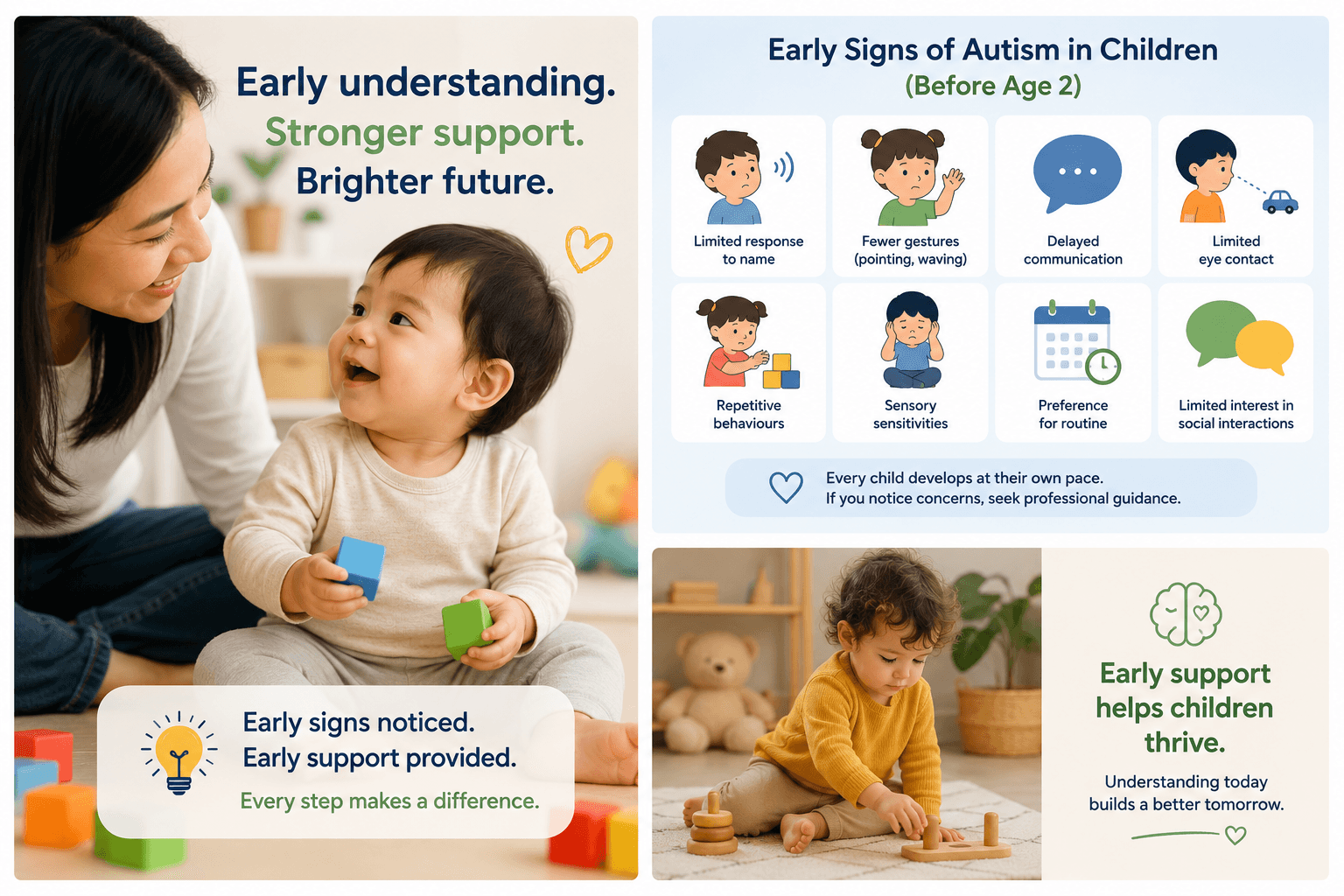
Early Signs Parents May Notice Before Age 2
Not every autistic child shows the same signs, and having one or two of these behaviours does not necessarily mean a child is autistic.
However, if you notice several of these consistently, it's worth discussing your concerns with a developmental professional.
1. Limited Response to Their Name
By around 9–12 months, many children consistently turn when their name is called.
If your child rarely responds—even when they can hear other sounds—it may be worth observing further.
2. Reduced Eye Contact
Some autistic children make less eye contact than expected or use eye contact differently.
Remember that eye contact alone should never be used to diagnose autism, but it may be considered alongside other developmental observations.
3. Limited Gestures
Children usually begin using gestures like:
Pointing
Waving goodbye
Reaching to be picked up
Showing objects to others
A reduced use of gestures may indicate differences in social communication.
4. Delayed Communication
Some children may:
Say very few words.
Lose words they previously used.
Communicate primarily by leading adults to what they want.
Rarely imitate sounds or expressions.
Speech delays alone do not always indicate autism, but they should be evaluated alongside other developmental areas.
5. Limited Shared Attention
One important developmental milestone is joint attention.
For example:
A toddler sees an airplane.
They point to it.
Then they look back at their parent as if to say,
"Did you see that too?"
Children who consistently struggle with shared attention may benefit from further evaluation.
6. Repetitive Behaviours
Some children may:
Repeatedly spin objects.
Flap their hands.
Rock back and forth.
Line up toys.
Repeat the same actions many times.
Repetitive behaviours alone aren't enough for a diagnosis, but they form one part of the overall developmental picture.
7. Sensory Sensitivities
Some toddlers may seem unusually sensitive—or less responsive—to sensory experiences.
Examples include:
Covering ears at everyday sounds.
Avoiding certain textures.
Becoming distressed by clothing labels.
Seeking spinning or jumping activities.
Fascination with lights or moving objects.
8. Preference for Routine
Many young children enjoy routines.
However, some autistic children may become extremely distressed when routines change unexpectedly or when transitioning between activities.
What Does an Autism Assessment Involve?
Parents often worry that a diagnosis is based on a single appointment.
In reality, autism assessments usually involve gathering information from multiple sources.
Professionals may:
Observe your child's communication and play.
Discuss developmental milestones with parents.
Review behaviour across different settings.
Assess language, social interaction, and adaptive skills.
Collaborate with educators if appropriate.
The goal isn't to "pass" or "fail" a child.
The goal is to understand how they communicate, learn, and interact so appropriate support can be recommended.
What If My Child Is "Too Young"?
Many parents hear advice like:
"They're just a late talker."
"Boys develop later."
"Wait another year."
While every child develops differently, trusting your instincts matters.
If you have ongoing concerns, it's okay to seek an evaluation.
Seeking guidance early doesn't mean something is definitely wrong.
It simply helps you understand your child's development more clearly.
What Happens After a Diagnosis?
Receiving a diagnosis can feel overwhelming.
But it can also provide clarity.
Instead of wondering why certain situations are difficult, families begin understanding how their child experiences the world.
Support after diagnosis may include:
Parent guidance and coaching.
Behaviour support.
Special education services.
School support.
Shadow teacher support, when appropriate.
Child and family counselling.
Every child's support plan should be individualised based on their strengths, goals, and needs.
Myths About Early Autism Diagnosis
Myth 1: "They're too young to diagnose."
Fact: Many children can be reliably diagnosed between 18 and 24 months.
Myth 2: "They'll grow out of it."
Fact: While children continue to learn and develop throughout life, autism itself is a lifelong neurodevelopmental condition.
Myth 3: "Let's wait until school."
Fact: Waiting may delay access to support during an important stage of development.
Myth 4: "Every speech delay is autism."
Fact: Speech delays can occur for many reasons. A comprehensive developmental assessment helps identify the underlying cause.
A Final Thought
No parent knows their child better than they do.
If you've noticed differences in your toddler's communication, play, or behaviour, don't ignore your instincts.
Seeking an assessment isn't about looking for a diagnosis.
It's about gaining a clearer understanding of your child's unique strengths, needs, and the support that can help them flourish.
Whether your child receives an autism diagnosis or not, early guidance can provide reassurance, direction, and practical strategies for supporting their development.
Need Support? We're Here to Help.
If you have concerns about your child's development or are wondering whether an autism assessment is the right next step, you don't have to navigate it alone.
At Insighte, we support families through every stage of their journey with services including behaviour support, special education, shadow teacher services, school support, parent guidance, and child & family counselling.
Connect with Insighte to learn how we can support your child and your family with understanding, compassion, and evidence-informed care.