

What Does a Shadow Teacher Cost in Bangalore?

If you are a parent looking for a shadow teacher in Bangalore, one of the first questions you are likely to ask is: “How much does a shadow teacher cost?”
And it's a fair question.
Shadow teacher fees in Bangalore can vary quite a bit. You may come across professionals offering support for ₹12,000–₹15,000 a month, while other services may charge ₹20,000–₹30,000 or more.
So, why is there such a big difference?
The answer isn't always about the shadow teacher themselves. Often, it comes down to what kind of support is built around the shadow teacher.
In this guide, we'll look at the typical cost of a shadow teacher in Bangalore, what affects the price, and what parents should consider before choosing a service.
How Much Does a Shadow Teacher Cost in Bangalore?
Based on publicly available Bangalore listings and current market references, shadow-teacher remuneration commonly falls somewhere around ₹15,000–₹30,000+ per month, depending on qualifications, experience, working hours and the child's support needs.
For example, current Bangalore listings include shadow-teacher roles in the ₹15,000–₹25,000 range, while some more experienced or specialised roles can reach ₹25,000–₹30,000 or more.
The current Learning Support Assistant roles in Bangalore have also been advertised in the ₹20,000–₹25,000 per month range as professional remuneration.

However, there's an important distinction:
A professional's salary is not necessarily the same as the fee a parent pays an organisation.
An organisation's parent-facing fee may also cover training, supervision, case management, monitoring, school coordination and other support services.
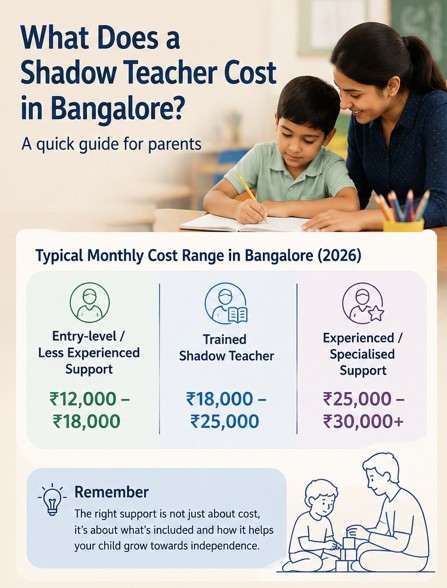
A broad Bangalore market reference
Type of support | Approximate monthly range |
|---|---|
Entry-level / less experienced support | ₹12,000–₹18,000 |
Trained shadow teacher | ₹18,000–₹25,000 |
Experienced / specialised support | ₹25,000–₹30,000+ |
These are broad market references, not fixed industry rates. Actual fees can vary depending on the child's needs, school hours, professional qualifications and the support model.
Why Do Shadow Teacher Fees Differ So Much?
If you come across shadow-teacher support for ₹12,000–₹15,000 a month, it's worth understanding what is included in that fee.
A lower fee doesn't necessarily mean poor-quality support.
It may simply mean you're paying directly for the professional's time, with fewer services included around them.
On the other hand, a higher fee may reflect a larger support system, rather than simply a more expensive shadow teacher.
For example, a professional support service may include:
1. Trained and carefully matched shadow teachers
The right professional isn't just someone who is available to sit beside a child.
Ideally, the shadow teacher should be matched based on the child's needs, personality, learning style and the type of support required in school.
2. Initial assessment and case understanding
Before support begins, understanding why the child needs support is important.
What are the child's strengths?
Where are they struggling?
Do they need help with communication, learning, attention, transitions, social interaction, emotional regulation or independence?
A better understanding of the child can help determine what kind of classroom support is actually needed.
3. Ongoing supervision
A shadow teacher shouldn't necessarily be left to figure everything out alone.
Regular supervision from a senior professional can help identify challenges, review strategies and make adjustments when the child's needs change.
4. A dedicated case manager
Some organised services have a case manager overseeing the child's support.
The case manager can act as a bridge between the child, family, shadow teacher and school, helping ensure that everyone is working towards the same goals.
5. Progress monitoring
Good shadow support shouldn't simply mean:
“The shadow teacher was present at school today.”
There should be some way of understanding whether the support is actually helping.
Progress may be monitored around areas such as:
Classroom participation
Task completion
Communication
Social interaction
Emotional regulation
Independence
Following routines
Reduced dependence on adult prompts
6. Parent and school coordination
Children spend their day across different environments.
If parents, teachers and the shadow teacher are all working in different directions, progress can become difficult.
Ongoing communication and coordination can help create a more consistent approach.
7. Continuous training
A shadow teacher may encounter situations they haven't dealt with before.
Ongoing training can help professionals develop their skills rather than relying only on what they knew when they first started the role.
8. Backup or replacement support
What happens if the shadow teacher is sick, takes leave or leaves the role?
When parents hire someone independently, finding a replacement may become their responsibility.
With an organisation, backup or replacement support may be part of the service.
So, Is a Cheaper Shadow Teacher a Bad Option?
Not necessarily.
If someone offers shadow support for ₹12,000 or ₹15,000 a month, it doesn't automatically mean they provide poor support.
They may be experienced, capable and a great fit for the child.
But parents should understand why the fee is lower and what is included.
Ask:
Is this primarily the cost of the professional's time, or does it include a wider support system?
Likewise, paying ₹25,000 or ₹30,000 doesn't automatically guarantee better support.
The important question is:
What are you getting for that additional cost?
If a higher fee includes trained professionals, supervision, case management, progress monitoring, school coordination, parent communication and backup support, you're not necessarily paying more for the same thing.
You're paying for a different model of support.
What Does a Shadow Teacher Actually Do?
The term "shadow teacher" can sometimes make it sound like the professional's job is
simply to sit beside a child throughout the school day.
That's not necessarily the goal.
Depending on the child's needs, a shadow teacher may support:
Understanding classroom instructions
Staying engaged with activities
Completing tasks
Transitions between activities
Communication
Social interaction
Emotional regulation
Following classroom routines
Managing challenging situations
Accessing the curriculum
Developing independent skills
The exact role should be based on the individual child's needs, rather than following a one-size-fits-all checklist.
Does Every Child Need a Shadow Teacher?
No.
A child may benefit from a shadow teacher when they need additional support to participate meaningfully in a mainstream classroom, but the level and type of support can vary significantly.
Some children may need intensive support throughout the school day.
Others may need targeted support for particular activities, transitions or situations.
And importantly, the goal shouldn't necessarily be for the child to have one-to-one adult support forever.
The Goal Should Be Independence
This is one of the most important things parents should consider when choosing a shadow teacher.
The purpose of support should not be to create dependence on an adult.
Ideally, support should help the child gradually develop skills that allow them to participate more independently.
That could mean:
Reducing prompts over time
Encouraging the child to communicate directly with teachers
Supporting independent task completion
Helping the child navigate classroom routines
Encouraging appropriate peer interaction
Gradually stepping back when support is no longer needed
So instead of asking only:
“How many hours will the shadow teacher be with my child?”
also ask:
“How is this support helping my child become more independent?”
Questions to Ask Before Hiring a Shadow Teacher in Bangalore
Before choosing based on price, ask a few practical questions.
About the professional
What is their educational background?
What training have they received?
How much experience do they have?
Have they worked with children with similar needs?
Will they receive ongoing supervision?
About the support
What exactly will they do during school hours?
How will their role be defined?
How will progress be monitored?
How will they work with the classroom teacher?
How will independence be encouraged?
About the organisation
If you are working with an organisation, ask:
How do you select and match the shadow teacher?
Is there a case manager?
Who supervises the professional?
How often is progress reviewed?
How do you communicate with parents?
How do you coordinate with the school?
What happens if the shadow teacher is absent?
Is there a replacement or backup system?
What kind of training does the professional receive?
These questions can tell you much more about the service than the monthly price alone.
Shadow Teacher Cost in Bangalore: What Should Parents Budget?
As a broad 2026 reference, parents researching shadow teacher fees in Bangalore may encounter prices ranging from approximately ₹12,000 to ₹30,000+ per month.
But treat this as a market range rather than a fixed price list.
The final cost may depend on:
Number of school hours
Child's support needs
Professional's qualifications
Professional's experience
Level of supervision required
Whether a case manager is involved
Progress monitoring
School coordination
Parent support
Training
Backup arrangements
This is why comparing two providers purely on their monthly fee can be misleading.
A ₹15,000 individual arrangement and a ₹30,000 professionally managed support service may not actually be offering the same thing.
Choosing a Shadow Teacher: Look Beyond the Price
When you're looking for support for your child, cost naturally matters.
But the better question isn't simply:
“Who is the cheapest shadow teacher in Bangalore?”
Instead, ask:
“What kind of support does my child need, and what is included in the service I'm paying for?”
Look at the professional.
Look at their training.
Look at who supervises them.
Look at how progress is monitored.
Look at how the school and family are involved.
And most importantly, look at whether the support is helping your child become more confident, capable and independent over time.
Because ultimately, the value of a shadow teacher isn't just measured by how many hours they spend beside your child.
It's measured by what that support helps your child achieve.
Looking for a Shadow Teacher in Bangalore?
At Insighte, shadow teacher support is part of a wider child-support system. Our Learning Support Assistants receive structured training and ongoing professional supervision, with support around case management, progress monitoring and coordination with the child's ecosystem.
If you're unsure whether your child needs a shadow teacher, or you're comparing different support options, talk to our team to understand what kind of support may be appropriate for your child.
Frequently Asked Questions
How much does a shadow teacher cost in Bangalore?
Shadow-teacher costs in Bangalore can broadly range from around ₹12,000 to ₹30,000+ per month, depending on qualifications, experience, hours, the child's needs and whether the service includes additional professional support.
Why are some shadow teachers cheaper than others?
The fee may differ because of qualifications, experience, working hours and the services included. An independently hired professional may have a lower fee because the arrangement primarily covers their time, while an organisation may include training, supervision, case management, monitoring and backup support.
Is ₹25,000- ₹30000 expensive for a shadow teacher in Bangalore?
Not necessarily. The value depends on what is included in the fee. A professionally managed service may include several layers of support beyond the shadow teacher's classroom hours.
Should I hire a shadow teacher directly or through an organisation?
Both options can work. Direct hiring may provide more flexibility, while an organisation may offer additional benefits such as professional matching, supervision, case management, progress tracking, school coordination and replacement support.
Does a shadow teacher help a child become independent?
They should. A good support plan should focus not only on helping the child manage the school day, but also on developing skills and gradually reducing dependence on adult prompts wherever appropriate.
Not sure what kind of support your child needs?
Talk to Insighte's team to explore the right learning support for your child.